ISOS Protocols for Perovskite Solar Cell Stability Testingペロブスカイト太陽電池の安定性試験 ISOS プロトコル
A plain-language guide to the consensus procedures used to test, compare and report the stability of perovskite and other emerging solar cells. ペロブスカイトなど次世代太陽電池の安定性を試験し、比較し、報告するための共通手順(コンセンサスプロトコル)を、わかりやすく解説します。
What are the ISOS protocols?
A good solar cell must do two things: convert light into electricity efficiently, and keep doing so for many years. Perovskite solar cells already reach efficiencies above 25 %, but they can lose performance when exposed to light, heat, moisture, oxygen or electrical bias. Improving their stability is now one of the most important goals of perovskite research.
For a long time, every laboratory tested stability in its own way — with different light sources, temperatures, atmospheres and ways of calculating the lifetime. Results from different groups could not be compared, and it was hard to learn which degradation factors really matter.
The ISOS protocols solve this by giving everyone the same recipes. They were first agreed at the International Summit on Organic Photovoltaic Stability (ISOS) and published in 2011 for organic solar cells [2]. In 2020, more than 50 researchers published a consensus statement in Nature Energy [1] that adapts the protocols to perovskite solar cells. ISOS describes three things:
- The stress — light, darkness, heat, humidity, outdoor sunlight, electrical bias, or cycles of these.
- The measurements during ageing — periodic J–V curves and, where possible, maximum power point tracking (MPPT).
- The reporting — which conditions and results to publish so that others can repeat and compare the test.
ISOS is not a certification. Unlike the IEC qualification standards for commercial modules (such as IEC 61215), a solar cell cannot “pass” or “fail” an ISOS test. ISOS is mainly for laboratory-scale cells and mini-modules, and its purpose is comparable, reproducible data. The correct way to describe a result is, for example, “measured following ISOS-L-1”.
ISOS プロトコルとは
優れた太陽電池には、光を効率よく電気に変換することと、その性能を長年にわたって保つことの二つが求められます。ペロブスカイト太陽電池はすでに 25 % を超える変換効率に達していますが、光、熱、湿気、酸素、電気的バイアスにさらされると性能が低下することがあります。安定性の向上は、ペロブスカイト研究の最も重要な課題の一つです。
これまでは、研究室ごとに光源、温度、雰囲気、寿命の計算方法が異なり、安定性の試験方法もばらばらでした。そのため、異なるグループの結果を比較することができず、どの劣化要因が本当に重要なのかを知ることも困難でした。
ISOS プロトコルは、全員が同じ「試験のレシピ」を使うことでこの問題を解決します。ISOS は有機太陽電池の安定性に関する国際会議(International Summit on Organic Photovoltaic Stability)で合意され、2011年に有機太陽電池向けに発表されました [2]。2020年には、50名を超える研究者がペロブスカイト太陽電池向けに拡張したコンセンサスステートメントを Nature Energy 誌に発表しています [1]。ISOS が定めるのは次の三つです。
- ストレス条件:光、暗所、熱、湿度、屋外の太陽光、電気的バイアス、またはそれらのサイクル。
- エージング中の測定:定期的な J–V 測定と、可能であれば最大電力点追従(MPPT)。
- 報告方法:他の研究者が試験を再現・比較できるよう、どの条件と結果を公表するか。
ISOS は認証制度ではありません。市販モジュール向けの IEC 認証規格(IEC 61215 など)とは異なり、太陽電池が ISOS 試験に「合格」「不合格」することはありません。ISOS は主に研究室規模のセルやミニモジュールを対象とし、比較可能で再現性のあるデータを得ることを目的としています。結果は、例えば「ISOS-L-1 に従って測定」のように記述します。
Why perovskite cells need special care
The 2020 consensus statement adds procedures for behaviour that is typical of perovskite solar cells:
- Recovery in the dark. Part of the performance lost under light can come back during a rest in the dark (and some cells even improve under light). Constant light and day / night cycles are therefore different tests — hence the new light-cycling protocols (ISOS-LC).
- Moving ions. Perovskites contain mobile ions. An electrical bias — for example a cell left at open circuit, or a shaded cell in a module driven into reverse bias — can move them and damage the cell. This is tested with the new bias protocols (ISOS-V).
- Hysteresis. The J–V curve depends on the scan direction and speed. Stabilized measurements or MPP tracking give a more reliable value than a single fast scan.
- Intrinsic or extrinsic? Degradation can come from the cell itself (light, heat, bias) or from the air (oxygen, moisture). Tests in an inert atmosphere (the “I” versions) separate the two.
ペロブスカイト太陽電池に特有の注意点
2020年のコンセンサスステートメントでは、ペロブスカイト太陽電池に特有の振る舞いに対応する手順が追加されました。
- 暗所での回復。光照射で低下した性能の一部は、暗所で休ませると回復することがあります(逆に光照射で向上するセルもあります)。そのため、連続光照射と昼夜のサイクルは別の試験になります。これが新しい明暗サイクル試験(ISOS-LC)です。
- イオンの移動。ペロブスカイトには動きやすいイオンが含まれています。開放状態に置かれたセルや、モジュール内で影になり逆バイアスがかかったセルなど、電気的バイアスによってイオンが移動し、セルが劣化することがあります。これを調べるのが新しいバイアス試験(ISOS-V)です。
- ヒステリシス。J–V 曲線は走査の方向と速度によって変わります。1回の速い走査よりも、安定化した測定や MPP 追従のほうが信頼できる値が得られます。
- 内因性か外因性か。劣化の原因には、セル自体によるもの(光、熱、バイアス)と、空気によるもの(酸素、水分)があります。不活性雰囲気での試験(「I」付きの試験)で両者を切り分けます。
Reading an ISOS test nameISOS 試験名の読み方
Every test has a short name that tells you the stress, how well it is controlled and the atmosphere. For example: 各試験には、ストレスの種類、制御の程度、雰囲気を表す短い名前が付いています。例えば次のとおりです。
ISOS-L-2I therefore means: light soaking at a controlled elevated temperature, in an inert atmosphere — one of the tests most often used to quote the lifetime of a perovskite cell. つまり ISOS-L-2I は「不活性雰囲気中、制御された高温での光照射試験」を意味します。ペロブスカイト太陽電池の寿命を示す際によく用いられる試験の一つです。
Seven kinds of stress7種類のストレス試験
Each family applies one kind of stress, or a combination. “OC” means the cell is left at open circuit; “MPP” means it is held at its maximum power point, as in real operation. 各試験は1種類、または複数のストレスを組み合わせて与えます。「OC」はセルを開放状態に置くこと、「MPP」は実際の発電時と同じく最大電力点に保持することを表します。
Dark storage暗所保存試験
The cell is kept in the dark and measured from time to time. Shows its shelf life: how it tolerates air, moisture and heat when not working. セルを暗所に保管し、定期的に測定します。発電していないときに空気・湿気・熱にどれだけ耐えるか(保存寿命)がわかります。
- Dark暗所
- OC
- RT, 65 or 85 °C室温・65・85 °C
Light soaking光照射試験
Constant illumination with a solar simulator — the classic “operational stability” test. At level 3 the cell must be held at its MPP. ソーラーシミュレーターで連続して光を当てる、代表的な「動作安定性」の試験です。レベル3ではセルを MPP に保持する必要があります。
- Light光照射
- MPP or OCMPP または OC
- RT, 65 or 85 °C室温・65・85 °C
Light / dark cycling明暗サイクル試験
Light switched on and off like day and night (cycle period 2, 8 or 24 h; light : dark 1 : 1 or 1 : 2). Reveals reversible losses and recovery. 昼と夜のように光を ON/OFF します(周期 2・8・24 h、明:暗 = 1:1 または 1:2)。可逆的な劣化と回復がわかります。
- Light ↔ dark明 ↔ 暗
- MPP or OCMPP または OC
Outdoor屋外試験
The cell works under real sunlight and weather. Not perfectly reproducible, but the most realistic test — and a reference for the laboratory tests. 実際の太陽光と天候の下でセルを動作させます。完全な再現性はありませんが、最も現実に近い試験であり、室内試験の基準にもなります。
- Sunlight太陽光
- MPP or OCMPP または OC
Thermal cycling温度サイクル試験
The temperature goes up and down in the dark (up to −40 ↔ +85 °C at level 3). Finds cracks, delamination and contact failures. 暗所で温度を上下させます(レベル3では −40 ↔ +85 °C)。クラック、層の剥離、電極の不良などを見つけます。
- Dark暗所
- OC
- Temperature cycles温度サイクル
Light + temperature (+ humidity) cycling光・温度(・湿度)サイクル試験
Light, temperature and humidity change together, as in a real day — the most complex laboratory “weathering” test. 実際の1日のように、光・温度・湿度を同時に変化させます。最も複雑な室内の「耐候性」試験です。
- Light光照射
- Temperature ramps温度変化
- MPP or OCMPP または OC
Electrical bias in the dark暗所での電気的バイアス試験
A forward bias (for example VMPP or Voc) or a reverse bias (for example −Voc) is applied in the dark, to study ion-related degradation. 暗所で順バイアス(例:VMPP、Voc)または逆バイアス(例:−Voc)を印加し、イオンに関係する劣化を調べます。
- Dark暗所
- Applied biasバイアス印加
Inert-atmosphere versions不活性雰囲気版
Any test with “I” at the end (ISOS-D-1I, ISOS-L-2I …) is done in nitrogen or argon, to separate the cell’s intrinsic stability from damage by oxygen and moisture. 末尾に「I」が付く試験(ISOS-D-1I、ISOS-L-2I など)は窒素やアルゴン中で行い、セル本来の安定性と、酸素や水分による劣化を切り分けます。
- N₂ / Ar
- Intrinsic stability内因的な安定性
Level 1, 2 or 3 — choose what your laboratory can controlレベル 1・2・3:研究室で制御できる条件に合わせて選択
Basic基本
Common laboratory equipment. Temperature (room temperature, 23 ± 4 °C) and humidity are monitored but not controlled. Recommended as the minimum for every stability study. 一般的な実験設備で実施できます。温度(室温 23 ± 4 °C)と湿度は記録しますが制御はしません。すべての安定性試験で最低限行うことが推奨されています。
Intermediate中級
The temperature is controlled at an elevated value — 65 °C or 85 °C — with an oven, hot plate or temperature-controlled holder. Humidity is still monitored. オーブン、ホットプレート、温度制御ホルダーなどで温度を 65 °C または 85 °C に制御します。湿度は引き続き記録します。
Advanced上級
Temperature and humidity are both controlled in an environmental chamber, giving the highest confidence. Illuminated tests must use MPP tracking. 環境試験槽で温度と湿度の両方を制御し、最も信頼性の高い結果が得られます。光照射を伴う試験では MPP 追従が必須です。
Test conditions at a glance試験条件の一覧
| Test試験 | Light during ageingエージング中の光 | Temperature温度 | Relative humidity相対湿度 | Electrical load電気的負荷 |
|---|---|---|---|---|
| ISOS-D-1 | None (dark)なし(暗所) | Ambient (23 ± 4 °C)室温(23 ± 4 °C) | Ambient周囲環境 | OC |
| ISOS-D-2 | None (dark)なし(暗所) | 65 or 85 °C (oven)65 または 85 °C(オーブン) | Ambient周囲環境 | OC |
| ISOS-D-3 | None (dark)なし(暗所) | 65 / 85 °C | 85 % (environmental chamber)85 %(環境試験槽) | OC |
| ISOS-V-1 | None (dark)なし(暗所) | Ambient (23 ± 4 °C)室温(23 ± 4 °C) | Ambient周囲環境 | Forward bias (VMPP, Voc, Eg/q, Jsc) or reverse bias (−Voc, −JMPP)順バイアス(VMPP、Voc、Eg/q、Jsc)または逆バイアス(−Voc、−JMPP) |
| ISOS-V-2 | None (dark)なし(暗所) | 65 / 85 °C | Ambient周囲環境 | Bias, as V-1V-1 と同じバイアス |
| ISOS-V-3 | None (dark)なし(暗所) | 65 / 85 °C | 85 % | Bias, as V-1V-1 と同じバイアス |
| ISOS-L-1 | Solar simulatorソーラーシミュレーター | Ambient (23 ± 4 °C)室温(23 ± 4 °C) | Ambient周囲環境 | MPP or OCMPP または OC |
| ISOS-L-2 | Solar simulatorソーラーシミュレーター | 65 / 85 °C | Ambient周囲環境 | MPP or OCMPP または OC |
| ISOS-L-3 | Solar simulatorソーラーシミュレーター | 65 / 85 °C | ≈ 50 %約 50 % | MPP |
| ISOS-O-1 | Sunlight (J–V under a solar simulator)太陽光(J–V はソーラーシミュレーターで測定) | Outdoor屋外 | Outdoor屋外 | MPP or OCMPP または OC |
| ISOS-O-2 | Sunlight (J–V under sunlight)太陽光(J–V も太陽光で測定) | Outdoor屋外 | Outdoor屋外 | MPP or OCMPP または OC |
| ISOS-O-3 | Sunlight (J–V under sunlight and a solar simulator)太陽光(J–V は太陽光とソーラーシミュレーターで測定) | Outdoor屋外 | Outdoor屋外 | MPP |
| ISOS-T-1 | None (dark)なし(暗所) | RT ↔ 65 / 85 °C (hot plate, oven)室温 ↔ 65 / 85 °C(ホットプレート、オーブン) | Ambient周囲環境 | OC |
| ISOS-T-2 | None (dark)なし(暗所) | RT ↔ 65 / 85 °C (oven, chamber)室温 ↔ 65 / 85 °C(オーブン、試験槽) | Ambient周囲環境 | OC |
| ISOS-T-3 | None (dark)なし(暗所) | −40 ↔ +85 °C | < 55 %55 % 未満 | OC |
| ISOS-LC-1 | Solar simulator ↔ dark (period 2, 8 or 24 h; 1 : 1 or 1 : 2)ソーラーシミュレーター ↔ 暗所(周期 2・8・24 h、1:1 または 1:2) | Ambient (23 ± 4 °C)室温(23 ± 4 °C) | Ambient周囲環境 | MPP or OCMPP または OC |
| ISOS-LC-2 | Light ↔ dark, as LC-1LC-1 と同じ明暗サイクル | 65 / 85 °C | Ambient周囲環境 | MPP or OCMPP または OC |
| ISOS-LC-3 | Light ↔ dark, as LC-1LC-1 と同じ明暗サイクル | 65 / 85 °C | Controlled (≈ 50 %)制御(約 50 %) | MPP |
| ISOS-LT-1 | Solar simulatorソーラーシミュレーター | RT ↔ 65 °C (weathering chamber)室温 ↔ 65 °C(耐候性試験槽) | Monitored記録のみ | MPP or OCMPP または OC |
| ISOS-LT-2 | Solar simulatorソーラーシミュレーター | 5 ↔ 65 °C | 50 % above 40 °C40 °C 以上で 50 % | MPP or OCMPP または OC |
| ISOS-LT-3 | Solar simulatorソーラーシミュレーター | −25 ↔ 65 °C | 50 % above 40 °C40 °C 以上で 50 % | MPP or OCMPP または OC |
OC: open circuit; MPP: maximum power point; RT: room temperature. Performance is measured periodically with J–V scans under a solar simulator (or sunlight for ISOS-O). VMPP, Voc and JMPP for ISOS-V are taken from the J–V curve of the fresh cell. The inert-atmosphere “I” versions keep the same conditions in N₂ or Ar. Simplified from Table 1 of Khenkin et al. (2020) [1]; see the article for the full details. OC:開放、MPP:最大電力点、RT:室温。性能はソーラーシミュレーター(ISOS-O では太陽光)による J–V 測定で定期的に評価します。ISOS-V の VMPP、Voc、JMPP は、試験前のセルの J–V 曲線から求めます。不活性雰囲気版(「I」付き)は同じ条件を N₂ または Ar 中で行います。Khenkin ら(2020)[1] の Table 1 を簡略化したものです。詳細は原著論文をご覧ください。
How is stability expressed? T80 and friends安定性の表し方:T80 などの指標
- T80 — the ageing time until the efficiency (PCE) has fallen to 80 % of its initial value. The most common lifetime figure.
- Burn-in and TS80 — many cells lose efficiency quickly at first (“burn-in”) and then much more slowly. TS80 is counted from the start of this stabilized period, as the time to lose 20 % of the value there.
- Cells that improve first — if the PCE rises at the start, T80 is taken as the time to fall to 80 % of the maximum.
- T95 — for very stable cells: the time to 95 % (IEC module tests also use a 95 % criterion).
- PCE after 1000 h — if T80 is not reached, age the cell for at least 1000 h and report the remaining PCE.
- Extrapolation — must be clearly marked, and should not go more than about ten times beyond the measured ageing time.
- Cycling tests — energy per cycle, or the average PCE per cycle, can be used instead.
- T80:変換効率(PCE)が初期値の 80 % に低下するまでのエージング時間。最も一般的な寿命の指標です。
- バーンインと TS80:多くのセルは、初めに効率が急速に低下し(バーンイン)、その後ゆっくりと低下します。TS80 は、この安定化期間の開始時点から、その時点の値の 20 % を失うまでの時間です。
- 初めに効率が上がるセル:初期に PCE が上昇する場合は、最大値の 80 % に低下するまでの時間を T80 とします。
- T95:非常に安定なセル向けの指標で、95 % までの時間です(IEC のモジュール試験も 95 % を基準としています)。
- 1000 h 後の PCE:T80 に達しない場合は、少なくとも 1000 h エージングし、残っている PCE を報告します。
- 外挿:外挿した値は明確に区別して示し、測定したエージング時間の約 10 倍を超えて外挿しないようにします。
- サイクル試験:サイクルごとのエネルギーや平均 PCE を指標として用いることもできます。
What to write down and report記録し、報告すべき項目
Even when a condition is not controlled, it should be monitored and reported. The consensus statement lists: 制御していない条件であっても、記録して報告することが求められます。コンセンサスステートメントでは次の項目を挙げています。
The cellセル
Device structure and area, how each layer was made, encapsulation (materials, edge sealant) or “unencapsulated”, and the number of samples tested under each condition. デバイス構造と面積、各層の作製方法、封止(材料、エッジシール)または「封止なし」、各条件で試験したサンプル数。
Initial characterization初期特性の評価
J–V: light source, intensity, spectrum and calibration, scan speed, direction, dwell time and preconditioning. MPP tracking: hardware and algorithm. EQE / IPCE if measured. J–V:光源、強度、スペクトル、校正、走査速度・方向・保持時間、前処理。MPP 追従:装置とアルゴリズム。測定した場合は EQE/IPCE。
Ageing conditionsエージング条件
Light source and intensity, cell temperature (and where it was measured), atmosphere, relative humidity (controlled or monitored), electrical load (OC, MPP, fixed bias) and the cycling scheme. 光源と強度、セル温度(とその測定位置)、雰囲気、相対湿度(制御または記録)、電気的負荷(OC、MPP、固定バイアス)、サイクル条件。
Measurements during ageingエージング中の測定
How often J–V curves were taken and with which settings, any rest or recovery before each measurement, and the MPP-tracking parameters. J–V 測定の頻度と条件、各測定前の休止や回復の条件、MPP 追従のパラメータ。
Results結果
T80 / TS80 / PCE after 1000 h and how they were determined, the absolute values used for normalized plots, and statistics over the samples. T80/TS80/1000 h 後の PCE とその求め方、規格化プロットの基準とした絶対値、サンプル間の統計。
Outdoor tests屋外試験
Location, dates and hours of exposure, and the weather: temperature, humidity, irradiance and wind. 場所、曝露の期間と時間数、天候(温度、湿度、日射強度、風速など)。
The authors also provide a ready-made reporting template (Excel, Supplementary Information) with the article [1]. 論文 [1] の Supplementary Information として、報告用テンプレート(Excel)も公開されています。
Good practice in the laboratory試験を行う際のポイント
- Prefer MPP tracking. Holding the cell at its maximum power point is the realistic operating condition and gives a reliable output even with hysteresis. Measure J–V curves periodically as well — they show why the cell degrades (Voc, Jsc or FF).
- Check the light. Lamps, especially xenon lamps, drift over a long test. Check the intensity regularly with a calibrated reference cell, and report the light source and its spectrum (xenon and metal-halide lamps contain UV; most white LEDs do not).
- Log temperature and humidity throughout the test, even at level 1. Dry air (below 20 % RH) and humid air are very different stresses for perovskites.
- Test several cells. Perovskite cells vary from cell to cell and batch to batch; one “champion” cell is not enough.
- Follow recovery. After the stress, keep the cells in the dark at open circuit and measure them from time to time until the values stop changing.
- MPP 追従を優先する。最大電力点への保持は実際の動作条件であり、ヒステリシスがあっても信頼できる出力が得られます。あわせて J–V 曲線も定期的に測定すると、劣化の原因(Voc、Jsc、FF のどれが低下したか)がわかります。
- 光を確認する。ランプ、特にキセノンランプは長時間の試験中に出力が変化します。校正済みのリファレンスセルで定期的に光強度を確認し、光源とスペクトルを報告します(キセノンランプやメタルハライドランプは紫外線を含みますが、多くの白色 LED は含みません)。
- 温度と湿度を記録する。レベル1でも試験中は常に記録します。乾燥空気(20 % RH 未満)と湿った空気では、ペロブスカイトへのストレスが大きく異なります。
- 複数のセルを試験する。ペロブスカイト太陽電池はセル間・ロット間のばらつきが大きいため、1個の「チャンピオンセル」だけでは不十分です。
- 回復を追跡する。ストレスを取り除いた後、セルを暗所・開放状態で保管し、値が変化しなくなるまで定期的に測定します。
VK-MPA-100: automated ISOS tests on six cellsVK-MPA-100:6セルの ISOS 試験を自動実行
The VK-MPA-100 Multi-Channel PV Power Analyzer runs ISOS stability tests on up to six cells at once, unattended. It holds each cell at its MPP, at open circuit or at a fixed voltage, scans J–V curves, switches the light, logs light intensity, temperature and humidity — and writes the final ISOS report in Excel when the test ends. VK-MPA-100 マルチチャンネル PVパワーアナライザーは、最大6セルの ISOS 安定性試験を同時に無人で実行します。各セルを MPP・開放・定電圧に保持し、J–V 曲線を測定し、光源を切り替え、光強度・温度・湿度を記録し、試験終了時には Excel の ISOS 最終レポートを作成します。
- Presets for ISOS-L, -LC, -D, -O and recoveryISOS-L、-LC、-D、-O、回復測定のプリセット
- T80, TS80, T95, burn-in and energy yieldT80、TS80、T95、バーンイン、発電量
- Reporting checklist in every data fileすべてのデータファイルに報告チェックリストを記録
- Light, temperature and RH logged with every reading光強度・温度・湿度をすべての記録に付加
SPD Laboratory pioneered MPPT for perovskite solar cell characterization, and presented embedded MPPT strategies for the stability monitoring of perovskite panels at ISOS-17 (Paris-Saclay, September 2026). SPD研究所はペロブスカイト太陽電池の評価に MPPT を初めて導入したパイオニアであり、ISOS-17(フランス・パリ=サクレー、2026年9月)ではペロブスカイトパネルの安定性モニタリングのための組込み MPPT 手法を発表しました。
ISOS-V (bias in the dark) needs an external bias source. The light source and any climate chamber are provided by the user. ISOS test sequences will also come to our other PV power analyzers in future updates; at present the VK-MPA-100 is the first ISOS-ready model. ISOS-V(暗所でのバイアス)には外部のバイアス電源が必要です。光源および恒温恒湿槽などはお客様にてご用意ください。ISOS 試験シーケンスは今後、当社の他の PVパワーアナライザーにも順次搭載する予定です。現在、ISOS に対応しているのは VK-MPA-100 です。
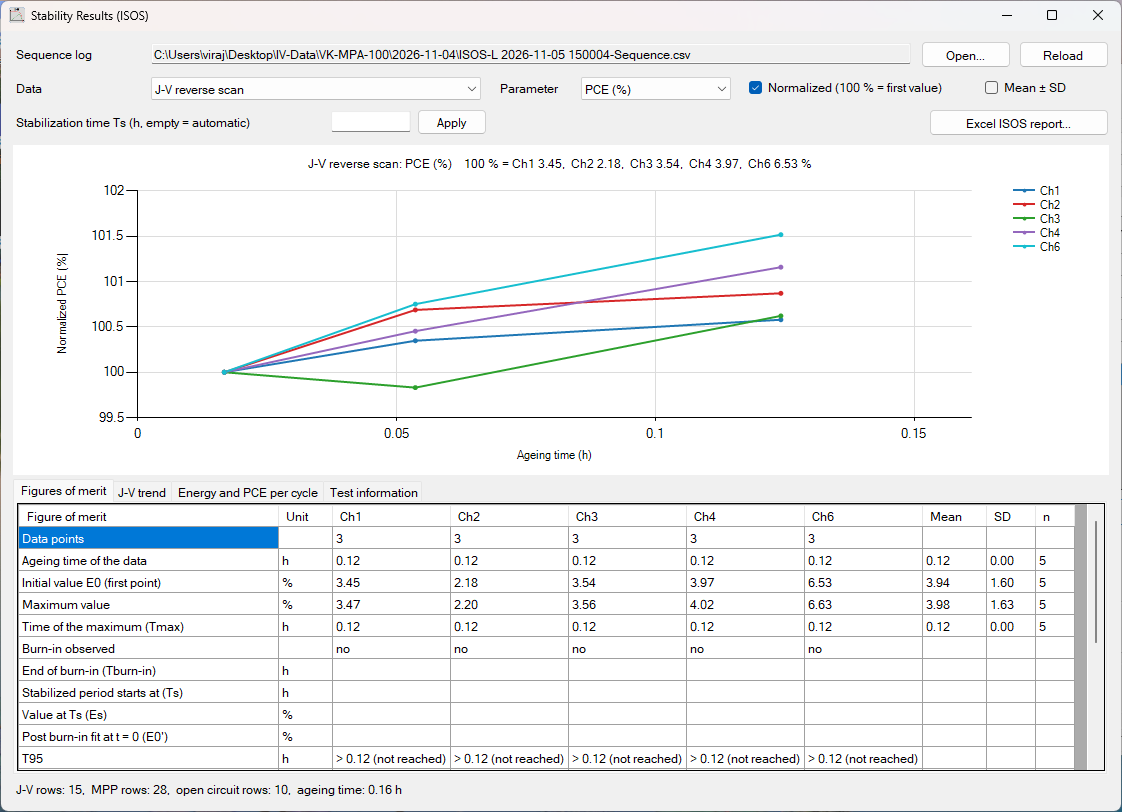
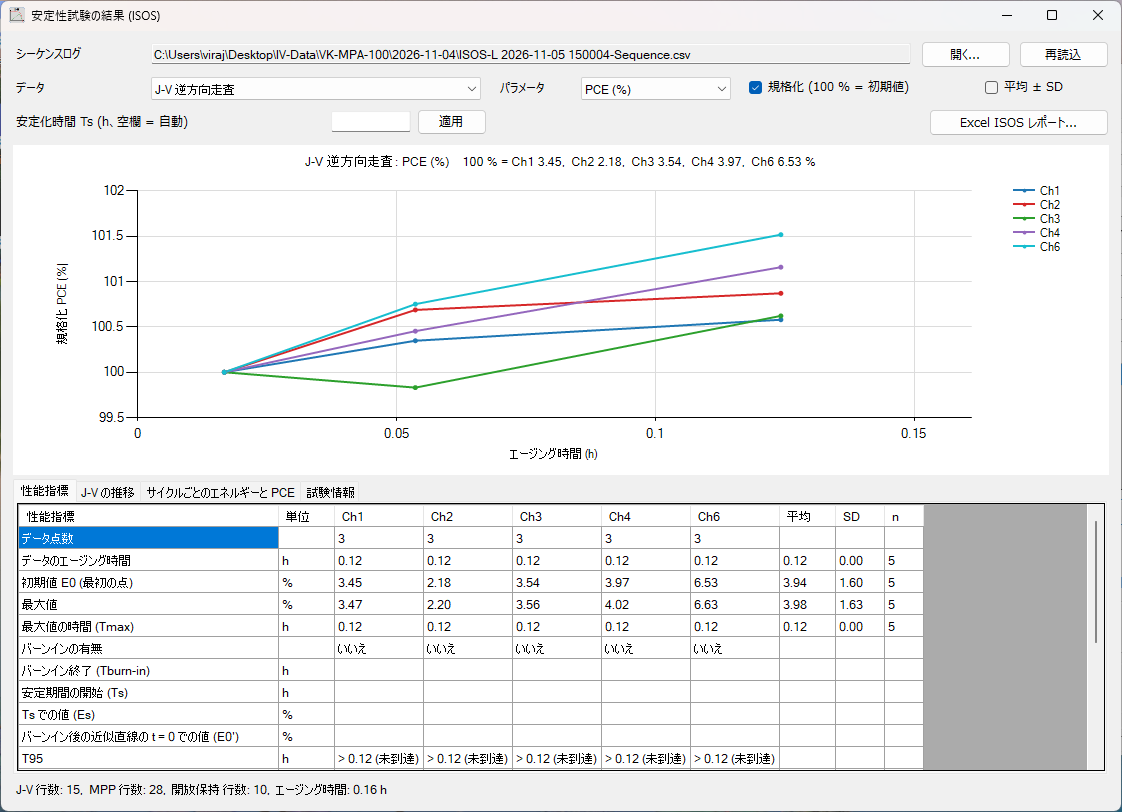
Instruments for a complete ISOS set-upISOS 試験の構成に役立つ製品
References and credit参考文献とクレジット
- M. V. Khenkin, E. A. Katz, A. Abate, et al., “Consensus statement for stability assessment and reporting for perovskite photovoltaics based on ISOS procedures”, Nature Energy 5, 35–49 (2020). DOI: 10.1038/s41560-019-0529-5
Article論文: https://www.nature.com/articles/s41560-019-0529-5
Supplementary Information (ISOS reporting template, .xlsx)Supplementary Information(ISOS 報告テンプレート、.xlsx): https://static-content.springer.com/esm/art%3A10.1038%2Fs41560-019-0529-5/MediaObjects/41560_2019_529_MOESM1_ESM.xlsx - M. O. Reese, S. A. Gevorgyan, M. Jørgensen, et al., “Consensus stability testing protocols for organic photovoltaic materials and devices”, Solar Energy Materials and Solar Cells 95, 1253–1267 (2011). https://doi.org/10.1016/j.solmat.2011.01.036
The explanations and the table on this page are simplified and adapted by SPD Laboratory, Inc. from reference 1, an open-access article published under the Creative Commons Attribution 4.0 International License (CC BY 4.0). The diagram was drawn by SPD Laboratory. This page is an introduction only; please follow the original article when planning and reporting a stability study. 本ページの解説と表は、オープンアクセス論文である文献1(クリエイティブ・コモンズ 表示 4.0 国際ライセンス(CC BY 4.0))を基に、株式会社SPD研究所が簡略化・編集したものです。図は当社が作成しました。本ページは入門用の解説です。安定性試験の計画と報告にあたっては、原著論文に従ってください。